
Keep Your Landscape Healthy with Proper Watering
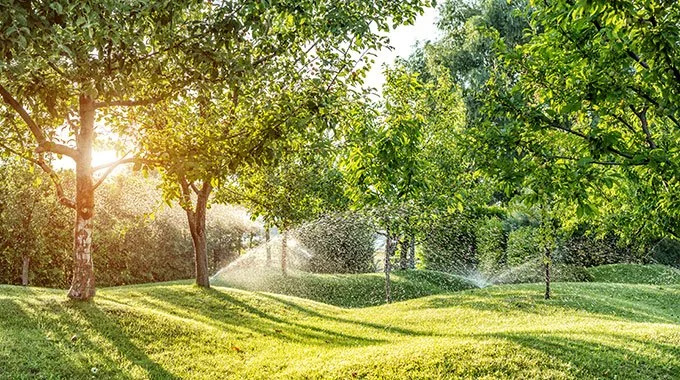
You should water less often but deeply, to encourage deeper roots. On average, try to leave the sprinkler or soaker hose on three times as long as you would for grass.
Though the summer season can be a relaxing time of year, it can be very stressful for your lawn. Heat, lack of moisture, humidity, insects, and disease are all by-products of the summer season that can take a serious toll on your turf.
As you walk around your yard this summer, keep an eye out for signs of stress. If your turf drifts away from the lush, green look you love, or if footprints remain visible in the turf after you’ve walked on it, your lawn may be suffering from stress due to insufficient irrigation or drought. In addition, brown patches of turf or lesions on grass blades are signs that insects or fungus diseases may be preying on your lawn.
Proper Watering Is Crucial
During the hotter summer months, your lawn will need from 1" to 1.5" of water per week, by either rainfall or watering. You can use a rain gauge to determine how much extra water will be needed each week. By soaking your soil to a depth of 6", you’ll help your turf’s roots to grow deeper and stronger.
Your trees and shrubs will also benefit from weekly irrigation when rainfall is scarce. Their roots are much deeper than those of your lawn, so it’s a good idea to soak each area thoroughly with each watering.
Keeping an Eye Out for Lawn Disease
Disease symptoms almost always include some sort of spotting on the leaves of the grass or other plants. On turf, the affected area may be the blade itself or the crown and sheath area (where the plant meets the thatch line). The spots (also called lesions) will vary in size and color and may sometimes be a simple straw-colored band across the leaf.
Don’t Forget Your Trees and Shrubs!
When was the last time you watered your trees and shrubs? Though it may seem like they do just fine on their own, the truth is that your valuable landscape plants can benefit from supplemental watering in the absence of rainfall.
Your trees and shrubs are always competing with the grass around them for water. Just like grass, they’ll provide visual cues when they need moisture. Browning leaves or wilting leaves and stems are good signs that your trees and shrubs need a drink.